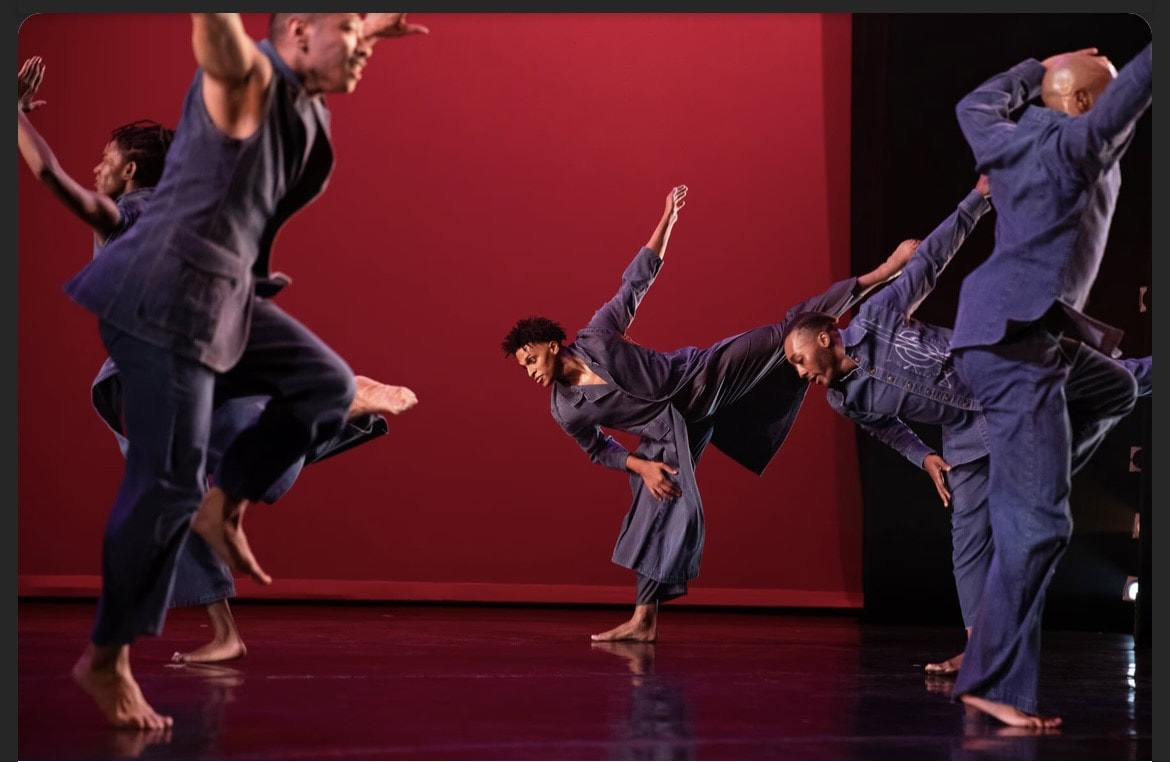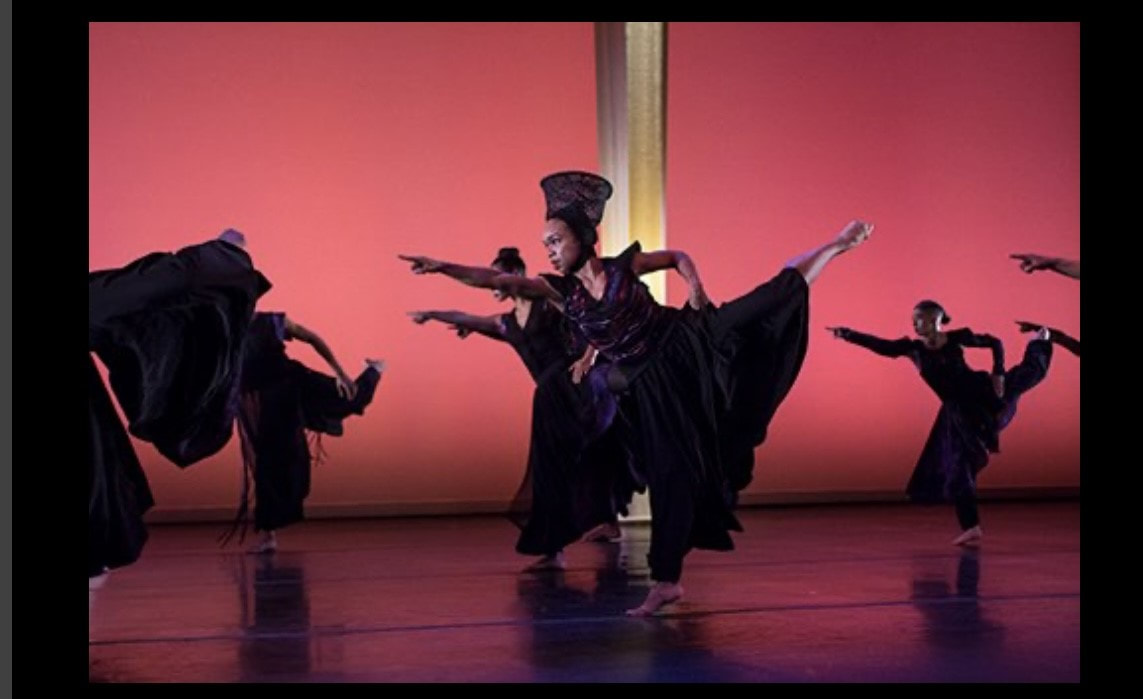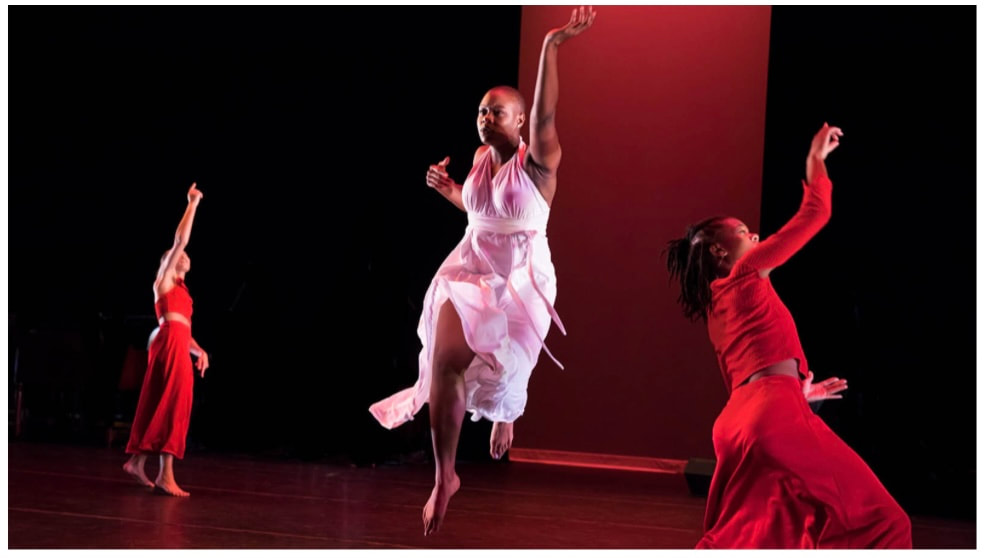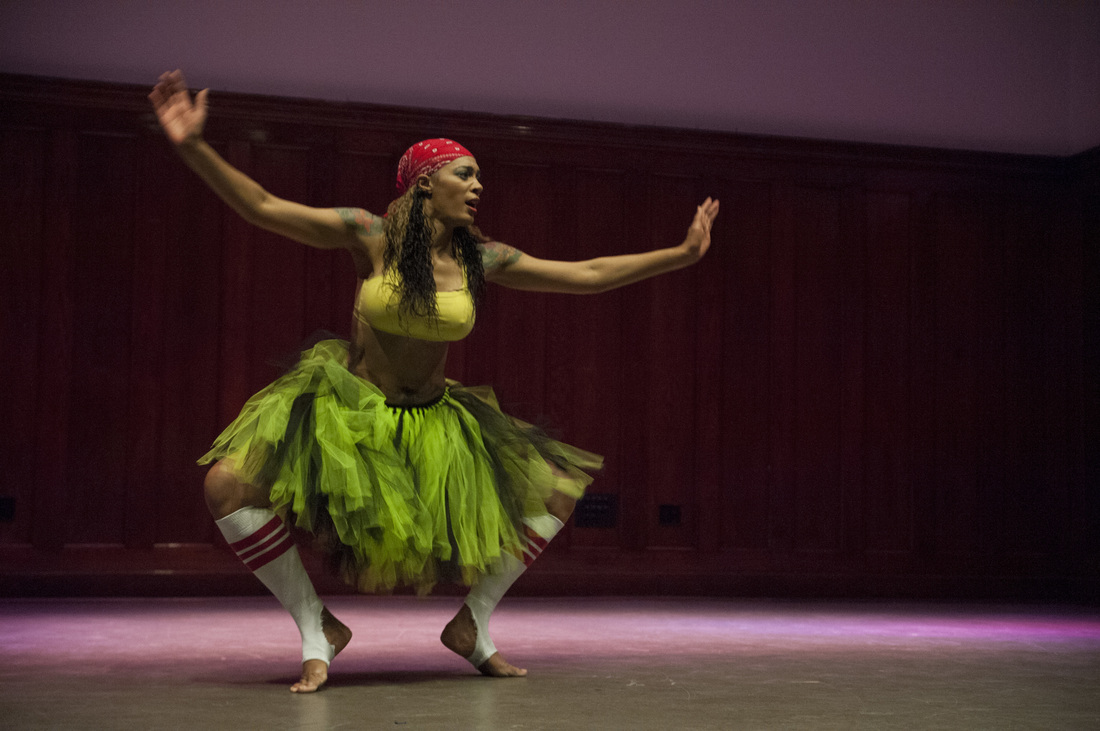
CaribFunk: A Caribbean Dance Technique and Fitness Program Developed by A'Keitha Carey
Add text
  • What is CaribFunk™?
  • Who is A'Keitha Carey?
  • CaribFunk™ Documentary
  • Areas of Interest
  • CaribFunk Fitness
  • Contact the Artist
  • CV
  • Blog
  • Solo Work
  • CaribFunk Fitness Mission
  • CaribFunk Fitness Videos
  • CaribFunk Images
  • CaribFunk in Pink

​Walshy Fire: Pull Up

9/29/2023

0 Comments

 
Picture
​Walshy Fire: Pull Up
 
Last night I attended the screening and art talk of Walshy Fire: Pull Up at the Pérez Art Museum Miami moderated by Dr. Patricia J. Saunders, Caribbean Studies Scholar, and Professor at the University of Miami who is also featured in the documentary. The documentary showcases the global impact of Walshy Fire who is a Chinese-Jamaican-American DJ (Leighton Paul Walsh). The documentary, directed by Jamaican-American filmmaker Alicia G. Edwards who is a beacon of light for the culture shared during the artist talk the rationale behind the documentary as well as the challenges in pitching this idea to PBS American Masters. She discussed having to justify why this was an important story to tell as well as the importance of “telling the culture from the inside.” Edwards shared her love of Dancehall as well as her enjoyment of her “bruk out” days attending Dancehall parties in the early 90’s when Miami was just ripe on the scene. 
 
The discussion between Saunders, Edwards, and Walshy Fire was informative, funny, and inspiring. Walshy Fire talked about “finding your passion,” the importance of “uncomfortability and shame” to get you moving,” the significance of “reinventing yourself” and “in life, you have to have an element of danger. If you’re not willing to jump the fence for it” then what is it worth? 
 
A profound moment occurred when an audience member shared that he suffered from chronic pain and that he felt healed while listening to Walshy Fire’s music. Walshy Fire responded with humility that “It’s healing him to hear him say that.” It is understood by many that music is a connector, it has the power to heal, educate, and it transforms lives. Another important element is that Dancehall music as well as the spaces where they occur are spiritual, “There’s a conversation between the DJ and the audience creating a kind of opportunity for consecrating the space and seeing the dancehall space as a spiritual space” (Saunders 2023).
 
Walshy Fire’s impact on Dancehall culture is massive, and as a Miami native and resident, we embrace and celebrate his fervent love, drive, and passion for music which he demonstrates through his artistry. South Florida is undeniably a Caribbean music, culture, and dance extravaganza, particularly Dancehall! This discussion is particularly important as just this morning on Good Morning America, which featured an exposé on Miami culture, subsequently and not surprisingly Afro Caribbean music and culture, Dancehall specifically was not represented. This is problematic—but I digress. Walshy Fire states, “In Miami you get Jamaican culture, central, south, American culture, Caribbean culture, then you get Black American culture, white American culture all mixed into this pot” (Walshy Fire 2023) so not acknowledging this representation, especially on such a major platform continues to perpetuate the myths of what Miami culture is and who and what it looks like (i.e., no one Black with African roots).
 
Final Thoughts: 
I am writing about Dancehall performance in my dissertation research, so it was important for me to attend the event. Thank you, Alicia G. Edwards, for advocating for the culture, thank you PBS American Masters for providing the platform, thank you Pérez Art Museum Miami for recognizing the importance and value of the work, thank you Dr. Saunders for you cultural academic prowess, and thank you to Walshy Fire for your unwavering love for music and Dancehall culture which you so generously share with the world. 


0 Comments

T.W.E.R.K. Summer Dance Intensive 2023 (Reflection)

8/26/2023

1 Comment

 
Picture

​This has certainly been a full summer of dancing, love, joy, power, African ancestral memory, and legacy. I have so much writing to share with you and I’m getting it out slower than I would like to but please know that it’s coming. I’m also believing and manifesting the right platform for all this dance and culture writing, and ohhhhh, the images that I am collecting; they are amazing!
 
What is T.W.E.R.K? T.W.E.R.K. is an acronym for (T)ransnational dance (W)orks and practices that (E)voke (R)evolutionary (K)inship. Michelle Grant-Murray, the Artistic Director of Olujimi Dance Collective birthed this project last year as a Summer Dance Intensive (T.W.E.R.K. originally started as a Black Artist Talk at Deering Estates in Miami, FL) at the Moss Performing Arts Center in Cutler Bay, Florida. This year’s intensive was a little different, we began with an Olujimi company professional development workshop facilitated by Wakumi Douglas a “social justice leader, organizer, educator/trainer, restorative justice practitioner, and ritualist” (www. wakumi.world/about) on Thursday, August 10th. The movement experience/teaching was only two days this year, commencing on Friday, August 11 and Saturday, August 12th with an informal showing of works by 4 of our local Black female extraordinary artists. 
 
This year’s movement offerings took us “from and within Kemet, West Africa, Cuba, Jamaica, the Bahamas, Haiti, Nigeria, Liberty City, Goulds, NYC, Georgia, Ghana, and Guinea” (Grant-Murray 2023). The teaching roster featured multi and inter-generational dance professionals: Baba Eddie DeCosta Dorman, Michelle Grant-Murray, Anita MacBeth, Marisol Blanco, Tiffany Merritt-Brown, Denzel Williams, Jennifer Rivera, Shanna Woods, A'Keitha Carey, and Tawanna Hall.
 
On Saturday afternoon, Olujimi Dance Collective initiated its first Olujimi Choreographic Incubator (The Secret Sauce- SAVE THE DATE: Oct 18, 19, 20) with innovative works of art by Dr. Keshia Abraham, Hattie Mae Williams, Shanna Woods (accompanied by Nicole Machadeo) and A'Keitha Carey. These women brought the house down with their ferocious energy and sublime artistry. Hattie Mae Williams offered “Quiet Cotton” which featured elements of “memory, addictions, and place within the memory/dreamscape.” Williams entranced us with her evocative performance to Ray Charles’s “Georgia on My Mind.” Williams’s head is covered in a scarf which remains on the entire piece. She maneuvers throughout the space connecting with, evading, and slapping several beer bottles. The clacking sounds of the beer bottles collapsing on the floor and spinning offer an eerie backdrop to the luscious vocals of Mr. Charles. The imagery is profound and transcends time. One is forced to reflect on many political, social, and personal themes which can make the viewer uncomfortable. Her pure movement vocabulary juxtaposes the raw themes. The piece is deeply transformative.
 
Dr. Keshia Abraham presented “Stories Our Bodies Carry.” This work is experimental and an exploration of word/sound/micro-movement which engages a sensory experience through word play and rest. Abraham wears a white flowing floor length gown. Dressed as a Queen, in royal fashion, she holds court. The audience is mesmerized by her soothing voice as she reads from her tablet/folder giving instructions for the audience members. She asks them to “close [their] lips, soften [their] jaw, [and] breathe out through the nose…” Dr. Abraham talks them through a sensory exercise that becomes a community experience. The vocalization of the woman singing on the supporting track is entrancing and spiritual, encouraging the spirit to ascend. 
 
Shanna Woods (accompanied by Nicole Machadeo) showed her untitled work in progress. This duet is a breath of fresh air. These women are floating through the space yet grounded in their bodies. Legs dig deep into the earth as their torso’s undulate and curve, sinuously carving space with their rhythmic phrases. They connect and disconnect from each other. Their relationship is sisterly, supporting each other and at times disregarding their connection. 
 
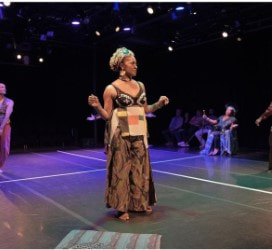
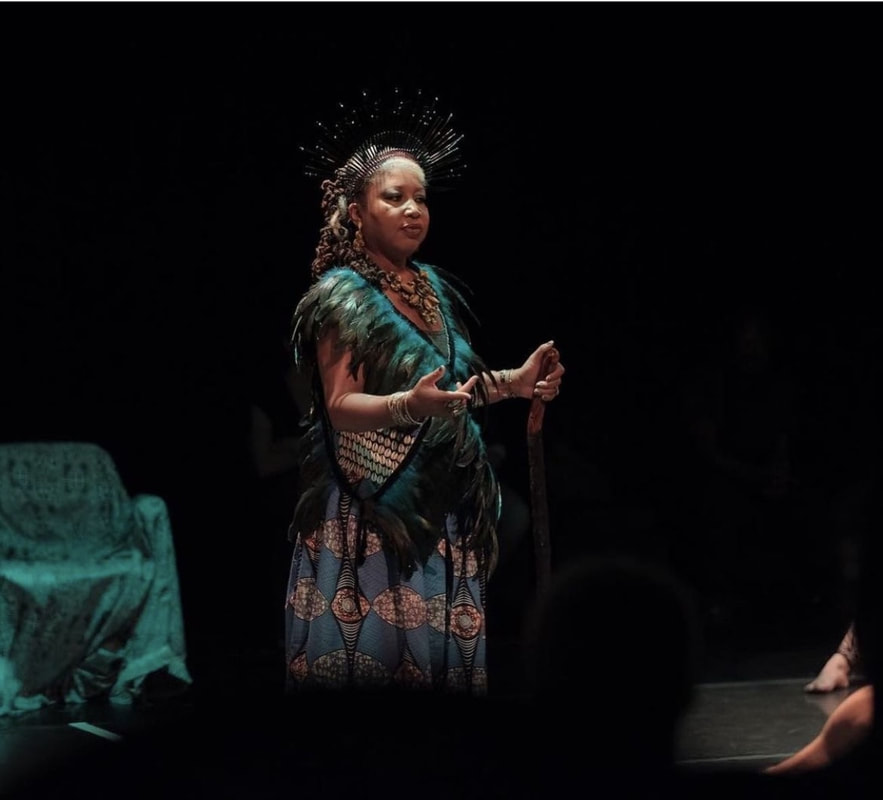
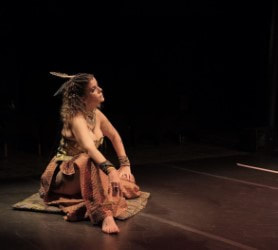
A'Keitha Carey closes the afternoon performance with “CariDad: Bahamian Warrior Woman.” Carey’s piece features ritual music and chanting as well as Afrobeat. Through spoken word she articulates that she is the daughter of the river goddess Oshun, goddaughter of Ogun, and protected under the Damballah loa. She also demonstrated this in her movement as she travels through the space building alters, conjuring up energy, and performing rituals building up the fortitude to prepare for battle. Carey takes no prisoners with her erotic performance displaying power, virtuosity (she is swinging that cutlass like and Agojie Warrior!), sensuality, freedom, [and] pleasure…” (Carey 2022). 
 
After the showing, there was a talk back/Q and A. The audience had an opportunity to hear more about each artists life story, their artistic process, and what influenced their work. They were encouraged to ask questions to gain greater clarity about what they witnessed and to share ideas about how to possibly advance the work. Questions ranged from “what were the identity and ancestry of each artist,” “what politics if any influenced the work,” and “what things they connected to/disconnected from and what they wanted more of.” Each audience member was given cue cards to write down their thoughts to be collected and shared (in a brown paper bag) with each artist.  

WE NEED MORE OF THIS! Well done Mama Michelle (I appropriated this phrase from Wakumi); the Olujimi Choreographic Incubator (The Secret Sauce) showing demonstrated the rich power of Black expressivity through the lens of African Diaspora aesthetics. The South Florida community (and nation) NEEDS to be exposed to this level of Black Female Artistry. Waaw Waaw!
Special thanks to the Moss Performing Arts Center, David Velasco (music director), Melodi Mellerson (volunteer and photographer), Jennifer Rivera (photographer) and all the student volunteers. 
​Images
1: AC Warrior Woman
2. Olujimi Dance Collect Retreat
3. Michelle Grant-Murray: Kimetic Yoga Class
4. Tiffany Merritt-Brown Afro Fusion Class
5. Hattie Mae Williams
6. Jennifer Rivera Hip Hop (House) Class
7. Dr. Keshia Abraham
8. Shanna Woods and Nicole M.
9. AC w/machete
10. Post Performance Talk Back


1 Comment

Rennie Harris University: Cipher/Deciphering Da Truth About Hip Hop and Street Dance

5/10/2023

0 Comments

 
Picture
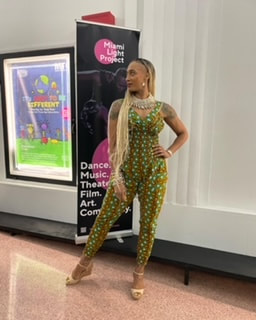
Walking into the space at Miami Light Project in Miami Shores, FL, I had no idea that I would be schooled in da realest dance history class. The ambiance was set, giving off a club vibe. The DJ spun tunes softly adding just the right element of club vibes. I scanned the room to see who was there, located our seats and made my way to the bar (okay!). There was a warm euphoria that was present as well as the spirit of community and family. Beth Boone, the Artistic Director and Executive Director came over and hugged both my son and myself. Brittany Williams, Managing Director of Rennie Harris University joined us, and we talked and laughed in our usual playfulness. Michelle Grant-Murray joined in the love fest. I sealed this moment with several photos.
​
The panel discussion titled “Rennie Harris and the State of Hip Hop and Street Dance took place during the Spring Cypher (May 5 -7th) which offered classes at Miami Dade Kendall Campus in a plethora of styles taught by local and national powerhouse dancers, practitioners, and scholars. Classes taught were B-boy Ynot (Rocking/Breaking); Cedric (Urban-Funk); J9 (Waving); Tawanna Hall (Hip Hop); Hot Rod (Hip Hop); Nubian Nѐnѐ (House Foundation/Waacking); Dr. Ayo Walker (Afro-Hip Hop/Dunham Technique); Pop Master Fabel (Popping/Boogaloo); Zedric (Urban Funk); Jip The Ruler (Wu-Tang/Jersey Club; Baltimore/Philly Club); Rennie Harris (House Basic Combo/Loft House Floor); and Hot Rod (Hip Hop Partnering/Hip Hop Philly Club).

Invited guests, RHU students, and all interested patrons arrived, and it was time to get it! Michelle Grant-Murray, Miami Dade College-Kendall Dance Program Director read a section Rennie Harris wrote from “There’s an Elephant in Da Room: The Mis-Education of Hip Hop Dance” In Beyond the Surface: An Inclusive American Dance History which she edited.  Speaking to the 2023 cohorts, Grant-Murray offered these pearls of wisdom, stating that they are on the “Verge of change…shifting the narrative. [She added that] paradigm shifts are essential for the world to change…Hip Hop dance and Hip Hop culture is the culture of America, it is the fabric that binds us together that makes things happen inside of the world that everyone wants to succumb to and when they get there, they bring themselves with them, they bring everything that they left with them” (Grant-Murray 2023).

Brittany Williams gifted us with more wisdom discussing the continued denial and marginalization of Black dance and culture, specifically Hip Hop; she states “we’re not just talking about Rennie, we are talking about a group of people who are innovating and risk taking, people who are challenging each other in the streets—that history has to continue to pass on with integrity, with love, with deep deep self-knowledge” (Williams 2023). This beautiful charge to action segues into her discussion of RHU. Brittany’s passion for this work is evident, her intentions are clear offering the audience an eloquent definition of the mission—"The mission of RHU is to develop intergenerational Hip-Hop and Street Dance artists and to foster skills, work habits, and a comprehensive understanding of Hip-Hop cultural phenomena, preparing them for success in the discipline” (RHU 2023).

She goes on say that they are not going to sit and wait for someone to give them permission to validate the culture and celebrate the gifts and talents of the community—this institution is the manifestation of the desire and hard work to push forward the vision of elevating Hip Hop and Street Dance.
A wonderful documentary “Hip Hop Dance Legend Rennie Harris Shares Five Major Moments | If Cities Could Dance” was shown which captured “five major moments in his life” providing context and (his)tory about the man known as “the high priest of Hip Hop” who believed that he was “going to feel God and see God” through his artistry. Two of the Spring 2023 RHU cohorts were introduced, Farrah McAdam: Cohort 2023 (from the Bay Area) and Jennifer Rivera: Cohort 2023 (Miami, FL). They shared their journey, how they are engaging with the art form, and where they are going with it.

After the scripture reading and praise and worship, we were ready for the word! The panel discussion moderated by Teo Castellanos was interactive, raw, and engaging. Each panelist: Rennie Harris, Nubian Nѐnѐ, Dr. Ayo Walker, Michelle Grant-Murray, and Pop Master Fabel brought their truth to the cipher to share, expound, theorize, clarify, and perform an authentic political and theoretical discourse that was empowering. Tao’s questions were provocative generating a range of emotion, debate, and theories.
  • Question 1: What does Hip Hop mean to you?
  • Question 2: Challenges and possibilities?
  • Question 3: How is it transforming and evolving?​
The responses from the panel provided themes such as 1. The issues with commodification and capitalism; 2. The need for certification; 3. The need to define our own thing; 4. Embodied knowledge versus written knowledge; 5. Documentation; 6. The importance of having Black and Brown folks on accreditation boards; 7. The lack of understanding of the culture; and 8. The Boriqua contribution to the culture (this question set it awffffff!). This took us all over the Boogie Down Bronx, Brooklyn, Philly, and Florida. Each question and response are worthy of its own dissertation. Rodney Hill, Executive Director of Rennie Harris Pure Movement was in the audience and offered his truth. It was a privilege to witness such brilliance. As Rennie Harris stated, in the midst of the disagreements, loud talking, and aggressiveness—this is what Hip Hop is. It is about community, family, and communicating “da truth.”  This should be the model for dance history and dance appreciation courses instead of the lecture based, non-interactive, racist, exclusionary, and ethnocentric models that are being used in many dance programs in the US.

Conclusion
Rennie Harris University (RHU) embodies Cipher/Deciphering. Cipher/Deciphering is an expression of the constant flow of riddim’—bodies performing stories—signifyin’ and bringing “da truth” to the space, classroom, floor, and/or street. For many of us that are involved in social justice work, we are Cipher/Deciphering, fighting, maneuvering, and performing our activism on multiple levels. Our strategies are cyclical, inclusive of the continuous rotation of involvement in coalitions and support groups. Our energy is exerted in unique ways, which includes teaching, creating curriculum, building coalitions and institutions, letter writing, organizing, and attending meetings, marching, creating artistic work, and performing that work etc.
​
Work Cited
Harris, Rennie. 2013. “There’s an Elephant in Da Room: The Mis-Education of Hip Hop Dance.” In Beyond the Surface: An Inclusive American Dance History, ed. Michelle Grant-Murray. Dubuque: Kendall Hunt.

Koed Arts. 2021. "Hip Hop Dance Legend Rennie Harris Shares Five major Moments/If CIties Could Dance." YouTube. https://www.youtube.com/watch?v=lGSGTrn5INA.

Image 1: AKeitha Carey and Tiago Carey-Smith
Image 2: Tiago Carey-Smith, Michelle Grant-Murray, and Brittany Williams
Image 3: Brittany Williams
Image 4: Beth Boone
Image 5: Michelle Grant-Murray
Image 6: Teo Castellanos
Image 7: Panelists
Image 8: Pop Master Fabel
Image 9: Audience
Image 10: Brittany Williams and Pop Master Fabel
Image 11: AC and Rennie Harris
Image 12: Michelle Grant-Grant Murray and Rennie Harris
Image 13: Brittany Williams and Rennie Harris
Image 14: Teo Castellanos and Rennie Harris
Image 15: 2023 RHU cohorts Farrah McAdam and Jennifer Rivera


0 Comments

Bridget Baker Whole Project… “Meadow”

5/3/2023

0 Comments

 
Picture

​Bridget Baker Whole Project… “Meadow”
When I pulled up at the Miami Dade Auditorium, it jogged a memory of my performance with Neri Torres and IFE ILE Afro-Cuban Dance Company on the main stage over 20 years ago. I was already in a state of nostalgia. I veered around the building to the entrance of the Black Box Theater. I walked into the building immediately seeking out places for photo ops to capture my attendance and add visuals to my writing piece. I entered the performance space and scanned the audience, taking in demographics of the patrons: age, gender, ethnicity, and race, how were they dressed, what energy were they giving, and what languages were spoken? As I locate my seat, I begin to think about the elements that guide my writing: what did I see (Warren 2022), what am I reminded of, how am I entering the work, what are the themes, references, and politics, and what scholarship supports my thoughts?
 
I sat down and began deeply listening to the pre-show playlist (Nina Simone: “I Think It’s Going to Rain Today”; Bing Crosby: “Paradise”, De La Soul: “Tread Water”, The Impressions: “Keep on Pushing”, and Moby: “We Are All Made of Stars”) wondering about the information conveyed and the temperament and character of the artistic director Brigid Baker. This was an eclectic playlist which revealed the range of musical interests of the curator. I scan the stage and see a cluster of items; one is a tall phallic object draped in gold fabric. Standing next to it was a shorter pointing object also draped in gold (shimmery) fabric with a gold ball at the tip. Hanging from that was a greenish shinny and shimmering tassel like attachment. Laying at the foot of the shrine was possibly a fish fossil and several other unrecognizable items. I wondered where and how I would enter the work.
 
Baker states that “Meadow” begins to deal with the light, via the cosmos. It is named for the composer Thomas Meadowcroft. The first piece, 'ABRACADABRA' is a laying down of grids and lines, a grounding of light into the material. The second piece 'arbadacarba', takes those same geometries, and lines and humanizes them” (Baker 2023). ABRACADABRA focuses on the “still point” and 'arbadacarba' travels and moves while committed to the same movement structure; “There is an homage to hip hop in the costuming, because along the road of this ascension process, hip hop is the last created American dance form. There's the black and gold of disco, because time spent in the clubs was a gathering of love” (Baker 2023).
 
This is what I saw…
 
The piece began with a series of short films; the first featuring women constructing, pasting, and painting a globe. This was fascinating because I had never thought about this process before. We always see the final product without considering how this is done, which is very meticulous. The second film showcased a spider maneuvering through a beautifully spun web. The third film demonstrates how a gold plate is molded into a particular shape. Next, we see some kind of magic trick, and the last film is an image of the earth expanding into the universe. The soundscape is soft and soothing. Viewing the galaxy in this manner reminds me of my experience at the planetarium. The next image is a gold liquid sun.
 
‘ABRACADABRA’: Three dancers, Meredith Barton, Isaiah Gonzalez, Amy Trieger enter the space dressed in all black—black leotard, black tights, and black ballet slippers with a thick gold choker necklace. There is a sameness and androgynous element which neutralizes the eye. The sterility of the stage encourages the viewer to focus on particular elements. The dancers roll a gold painted medicine ball-like prop over each other as they travel across and down the stage performing the same pattern. It becomes meditational and ritualistic. The video images of vibrant color add depth and texture to the space. The dancers partner each other, cut, carve, and mold with their extremities, holding positions—arabesque and attitude. Their faces are stoic. The gaze is internal, “eschewing emotion, glamour, and…favoring a deadpan, paced delivery that aime[s] to render a dancer an impersonal agent: a “neutral ‘doer,’’’ (Morse 2008, 55). The dancers are fierce technicians performing leaps, extensions, assemblé’s, waltzes, and  triplet phrases with beautifully shaped arms, “This striking ensemble is all the more eloquent because the choreography allows no transitions between successive movements. The dancer is fully involved in one movement and then immediately engages in the next” (Foster 1986, 13).
The sound scape transformed the space with screeching flute like sounds that built and regressed creating a soundtrack to the movie I created in my head. There was a feeling of familiarity that I was unable to pinpoint immediately. As the work progressed, I continued to develop my own narrative, I envisioned an other worldly experience. The dancers were traveling the galaxy similarly to the “Lost in Space” rerun episodes from the 1960’s that I watched as a kid in the 80’s. I wondered “What were they seeing?” and  “What is their mission?”
During intermission, seconds before the dancers returned, a young man in the front row asked me what my perspective was and “What did I get from this?” I wondered about the purpose of his questioning. Was it for clarity for him or was he testing me. I explained to him that I was a dance writer and what that there were many things to take into consideration—the movement, costume, spatial design, setting, music and how all of these things connected or not and that question couldn’t be answered in 5-10 seconds. As an informed viewer and an educator, I questioned if my response was sufficient, useful, or helpful.
'arbadacarba’: The dancers returned in a change of costume—they added flowing black pants, a black tunic top, black ballet slippers and an even chunkier necklace. The second half began with a video of the galaxy, it was textured—the moon. The image switched to a lava-ish, orange/red picture. The music is light, the focus is brighter. There was a shift. The movements are more open and freer. There is more breath in the body and the couples move with more connection, engagement, and eye contact. They look out into the audience and include us in their intergalaxy journey.
Image 1: Justin Trieger
Image 2: Justin Trieger
Image 3: Justin Trieger
Image 4: Justin Trieger
Image 5: Justin Trieger
Image 6: Karime Arabia
Image 7: Karime Arabia
Image 8: Brigid Baker
Image 9: A’Keitha Carey
 
*Choreography, Set Installation, Costumes and Movies: Brigid Baker
*Sound Design and Video Projection Artist: Justin Trieger
*Building Assistant: Meredith Barton
 
Citations:
Foster, Susan. 1996. Reading Dancing: Bodies and Subjects in Contemporary American Dance. Los Angeles: University of California Press.
Morse, Meredith. 2018. “Minimalist” Dance, Social Critique: Revisiting Yvonne Rainer and Steve Paxton’s 1963 Word Words.” 

0 Comments

Dancing, Mothering, and Black Womanhood: Shanna Woods

5/1/2023

0 Comments

 
​Shanna Woods is a dance artist, educator, entrepreneur, and mother from Delray Beach, FL.  She describes herself as the “Sweetest mango with a dash of ghost pepper.” This description offers some insight into the personality of this Queen and visually piques the interest of the reader. Who is this sweet and spicy woman? Shanna has an extensive resume having performed nationally and internationally with Deeply Rooted Dance Theatre, Cleo Parker Robinson Dance Theatre, Jubilation Dance Ensemble and currently with Olujimi Dance Theatre. She has a musical theater background as well—her credits include “Deena Jones in Dreamgirls, The Wiz, The Producers, Ethel in Memphis The Musical, and dance captain for Man of La Mancha and The World Premiere A Wonderful World and Mayme in Intimate Apparel” (https://www.shannawoods.com). She is certified in KAY Yoga for Children, AkhuYoga, and Kemetic Yoga and she developed the “Art of Acceptance” self-care workshop series. Shanna is the Director of Dance at Boynton Beach Community Highschool, and founding member of Florida Black Dance Artist Organization, and is currently the first Artist in Residence at Bailey Contemporary Arts Center in Pompano Beach, Fl. Okay Sis, we see you!
 
My relationship with Shanna is multi-dimensional. I first met her as a student at Miami Dade College Kendall when she took my CaribFunk class. We currently dance together in the Olujimi Dance Collective. I have supported her business “Lavish Lovin’ Skin Soul Care Line products (the skin is giving island tropics hunny!) and we cofounded The Florida Black Dance Artist Organization with several other local dance artists. I have watched her mother her daughter Lilian with a fierce tenacity and incredible love, instilling African principles.  Ms. Lilian is quite often adorned in African print clothing; she is exposed to Black/African books and authors and enrolled in African dance and Capoeira classes and both of their hair is beautifully locked. I have also listened to Shanna discuss the joys and pains of teaching dance in K-12 which has produced numerous squawks and gut busting howls. It is truly inspiring to see how Shanna is mothering her daughter in a very intentional manner, educating her about the beauty, brilliance, and resilience of her ancestors. This sensibility is transposed into the classroom where it is evidenced that she is practicing motherwork, “this type of [work] recognizes that individual survival, empowerment, and identity require group survival, empowerment, and identity” (Collins 1994, 374).
 
Black womanhood has produced a narrative that has negatively impacted the lives of many, “Black women have been victimized by the sociopolitical racist and sexist ideologies that control the discourse entrapping Black females” (Gammage 2019, 9) but we can overcome these abuses by centering our survival, power, and identity (Collins 1994). Shanna’s new work “Rituals” addresses this. “The dance work, Rituals, challenges my thoughts around survival, thriving, rest and joy. In the past, I felt like I was always in survival mode out of fear, trying to make it through, and barely sustaining myself and my daughter. Rituals is an exploration of my desire to thrive with the intersections of joy and dream. As a Black woman, it is my experience that Black folk always innovate laughter, music and dance even in our times of sorrow. One thing we forget is that we deserve to rejuvenate our minds, bodies, and spirits” (Woods 2023). Through storytelling, play, movement, visual art, spoken word, and music, the audience is drawn into a love letter offering healing to women, children, and the community.
My son and I attended the show at Bailey Contemporary Arts on Friday, April 7, 2023. The performance took place during the “Old Town Untapped” event which is an outdoor street festival with live, music, DJ, art gallery openings, craft beer, street vendors, and food trucks. (https://www.pompanobeacharts.org/events/untapped?mibextid=Zxz2cZ). Admittingly, I was a bit confused because what I saw versus what I was expecting didn’t match. I made a phone call to Michelle Grant-Murray to get some clarity and stumbled upon Shanna and Lilian standing outside the building. Lilian was saging/smudging her mom before they entered the space; I immediately felt at ease and recognized that I was indeed in the right place. Shanna took her seat in front of a video which featured Michelle Grant-Murray speaking; Lilian is standing behind her.  The video ends and Shanna acknowledges the earth. Shanna rises, moving through the space with a ferocious calm. Elegantly dressed in all white—white pants and a white off the shoulder top with a black cowrie shell bra underneath, she cuts through the room with her brown extremities reaching through, above, and beyond the watchers and finds her brief resting place seated on the floor—Lilian finds her seat in the same chair.  
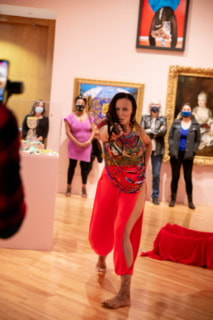
 
Lilian is dressed in white pants, a white long sleeve shirt with blue fabric wrapped around her waist. She opens her book and takes us on a journey. She references Yurugu throughout the reading. Yurugu is “A being in Dogon Mythology which is responsible for disorder in the universe. This is a being conceived in denial of the natural order, which then acts to initiate and promote disharmony in the universe. In African Cosmology such a being is deficient in spiritual sensibility, is perpetually in conflict, is limited cognitively, and is threatening to the well- being of humanity” (Ani 1994, xxviii). Lilian reads a few lines that are powerful and potent, resonating and affirming with such depth: “I need community. I need people who are going to share and critique…It’s about partnership, that is something I desire.” 
 
Shanna’s movement vocabulary demonstrates the multitude of techniques and aesthetics that she has been exposed to with a layer of Black womanhood, magic, confidence, pain, and joy. She embodies sensuality and play. Her hips circle, wine, and skank positioning her pelvis to give and receive. The cadence of her body shifts responding to the text. She makes her way to the outer realm of the room and leads us up the stairs. The audience follows her, most can’t see. They can only imagine what is taking place in the narrow stairwell. The mood has shifted. The energy is high, and the sound is cutting. The instrumentation is wild and eerie, and Shanna’s body matches it. The sound changes to a lighter flow and the female voice is soothing, singing “I saw things, I imagine…” This shift is refreshing for both the viewer and those who were on the outskirts imagining what was going on. 
 
Shanna makes her way up the stairs and into the center area that is partitioned off. The audience follows. She turns her back to us and changes her clothes. She takes off her top and pants and puts on a white flowing spaghetti strap dress. There is a woman speaking in a gentile tone. I hear her say “She guards her authenticity as carefully as she guards her baby.” The act of mothering everyone and anything is powerful. 
 
Shanna methodically takes a piece of fabric and wraps her hair. The audience is mesmerized. She walks over to the table which has several liquid and colorful items on it. She places her hand in a bowl, submerges it in the concoction, removes it, walks over to the wall and begins hand painting. Shanna voice is illuminated piping loudly through the speakers; she offers us a manifesto of self-love. Her soothing voice is therapeutic and healing. I am drawn into the words of affirmation and declaration. She offers:  
 
“I desire to liberate myself from ancestral depression”
“Inside me is an empire’
“I desire to love and be loved without ownership”
 
A Black woman to my right is weeping. My soul leaps. I am grateful. I am drawn into the ecstasy that is abundant in her smile. This is the embodiment of Black womanhood. 
 
#dancewriter
#culturalcritic
#blackwomanhood
#artofacceptance
#shannawoods

​Image 1: Shanna Woods
Image 2: Michelle Grant-Murray
Image 3: Shanna Woods
Image 4: Shanna Woods
Image 5: Lillian S. Harris
Image 6: Shanna Woods
Image 7: Shanna Woods
Image 8: A’Keitha Carey at Affirmation Wall
Image 9: Affirmation Wall
Image 10: Shanna Woods
Image 11: Lillian S. Harris
Image 12: Olujimi

**There was an area set up where you were asked to write/set your intentions and place them in the designated area. She also provided mini tubes of body butter and invited guests to her workshops: Shea Butta, Movement Meditation, Kemetic Yoga, Mango Butta.
 
Citations
Collins, Patricia H. 1994. “Shifting the Center: Race, Class, and Feminist Theorizing About Motherhood.” In Representations of Motherhood, ed by Donna Bassin, et al., 371- 387. New Haven: Yale University Press.
 
Gammage. Marquita. M. 2019. “Introduction.” In Challenging Misrepresentations of Blackwomanhood: Media, Literature, and Theory, eds Marquita M. Gammage and Antwanisha Alameen-Shavers, 8-18. New York: Anthem Press. 
 
Marimba, Ani. 1994. Yurugu-An African Centered Critique of European Cultural Thought and Behavior. Trenton: Africa World Press. 


0 Comments

​A.I.R. Dance Conference 2023 Artistry in Rhythm: Balancing Tradition Review

4/28/2023

0 Comments

 
Picture

It is with great pleasure to share my thoughts on this season’s A.I.R. Dance Conference titled and themed “Balancing Tradition.” A.I.R. is the acronym for Artistry in Rhythm and it is certainly that. I began my A.I.R. journey six years ago when I moved back to Florida. I participated as a performer, choreographer, teacher, lecturer, and now as a dance reviewer and critic; I am amazed at the evolution of the conference. I think it was stated that this is the 11th year (correct me if I’m wrong) that Mrs. Michelle Grant-Murray has blessed the South Miami community with this conference. Over the years, I have seen the participation fluctuate but never did Grant-Murray’s level of excellence waiver. She continues to pour into her students’ lives as well as the community, imparting grandiose wisdom and experiences through this conference. A.I.R. offers “A synthesized historical, cultural, and philosophical experience that explores dance, music, visual arts, and the aesthetic of a global narrative that grounds and expands the innovative practices of art making” (Grant-Murray 2023). Participants travel through the embodied, theoretical, scholarly, and artistic worlds “engag[ing] in masterclasses, panel discussions, artist talks, performance, and scholarly presentations” (Grant-Murray 2023).
 
Every year Grant-Murray recognizes a national powerhouse in the dance world, this year the awardee was Kevin Iega Jeff: Renowned dancer, award winning choreographer, and Co-founder/Artistic/Executive Director of Deeply Rooted Dance Theater (DRDT). She also recognized South Florida Power of the Arts Honorees: Commissioner Kionee McGhee, attorney and author of the best-selling book Conquering Hope: The Life You Were Destined To Live; Marion “Neise” Sneed: (Branch of Hope: Supporting Individuals and Families Impacted by Incarceration); Leatha Bush (Survivors Affected by Violence); and Romania Dukes (Mothers Fighting for Justice). Tiffany Meritt-Brown, currently a Visiting Professor at the University of Iowa received the “Distinguished Alumni Award in Artistry.” She also taught an Afro-Fusion contemporary class. The conference featured many Miami Dade College Kendall alumni as performers, choreographers, and teachers as well as local and national guest teachers and lecturers. Several featured guests are quintessential in their area such as A.I.R. Resident Choreographer Paunika Jones, Former Principle with Dance Theater of Harlem; Dr. C. Kamal Nance (Umfundalai Technique); Dr. Keisha Abraham (A Jedi Framework); and Marisol Blanco (Afro Cuban) to name a few. 
 
Performances are crucial elements transmitting knowledge, memories, histories, traumas, and identities (Taylor 2003 and Schechner 2013 and 2006) and within this construct, whether within the role of performer or observer “within cultural performances…we often come to realize truths about ourselves and our world that we cannot realize in our day-to-day existence (Madison 2020, 150).
 
Cultural performance “…include[es] ritual, ceremony, carnival, theatre, and poetry, [which] is an explanation and explication of life itself…” (Madison 2020, 146). As I watched the performance, I thought about how these elements were displayed in various forms through multiple representations of nationhood. Diana Taylor in The Archive and the Repertoire: Performing Cultural Memory in the Americas discusses how it is important to “keep examining the relationships between embodied performance and the production of knowledge (Taylor 2003, xvii -xv). The program was full of knowledge, offering a range of styles and aesthetics which were clear representations of African spirituality, fusion, womanhood, struggle, history, balance/imbalance, community, freedom, power, and tradition. There is not enough time or word count to discuss the luminous works featured on the program. I will briefly discuss three works that embodied this notion of cultural performance: they “transmitt[ed] knowledge, memories, histories, traumas, and identities (Taylor 2003 and Schechner 2013 and 2006). 
 
“Rituals” choreographed and performed by Shanna Woods featuring her daughter, Storyteller Lillian S. Harris. This mother-daughter duet is powerful. Harris is seated narrating a fable/myth dropping pearls of wisdom while Woods crawls through and over the chairs and small square tables. Harris exits stage right and Woods devours the space, conjuring, shapeshifting, asserting her power and revealing her feminine energy. African aesthetics are ripe and rich. She speaks of her history, heritage and offers affirmations focused on healing and self-love. Yasssss!
 
“Dame La Receta!” choreographed by Chachi Perez in collaboration with David Velazco (Musician), Jennifer Rivera (dancer) and Genesis Castaneda (dancer) offered a kaleidoscope of rhythm, movement, and vocalization that sucked you into their Spanish familia. The playfulness juxtaposed with ritual offered a comedic element to the work. The Orisha Yemaya was present. The rich blues of the costumes were captivating on each woman. The unspoken and the bodily narratives, winin’ hips, live drumming, beating of the pots and pans, and the constant rhythmic changes, pulled they audience inward to the next dimension. 
 
“InterDimensions: ACTIVATED” choreographed by Jennifer Rivera in collaboration with the cast brought the house down. Shango showed up and showed out. Each dancer was in it and received the spirit. Rivera is one to watch. Her aesthetic choices which include Hip Hop, House, Contemporary, and Afro Cuban, are full bodied, flavorful, and caliente! The red costumes, flaming energy, and warm lighting are the right combination—the audience agreed. They were moving, clapping, and smiling. 
 
At the end of show Dance Department Alumni and former Jubilation Dance Ensemble (JDE) President Brittany Williams discussed Grant-Murray’s purpose and vision for the conference when she presented her with a Certificate of Excellence at the Saturday show. The moment was impactful in many ways, yes, as Williams stated, “give them their flowers while they are alive” because there is no doubt that she is so deserving of this recognition, for her impeccable work and brilliance but Williams stated that Grant-Murray was addressing a need. The Black and Brown students in the community needed a place where they could dance, create, and explore, particularly in forms, vocabularies, and languages that were innate and germane to their ancestry while exposing them to new experiences and other technologies that they could draw upon, engage with, and coalesce. So, when you consider the theme “Balancing Tradition” and the conference offerings in terms of classes in Hip Hop, Contemporary, House, Kemetic Yoga, Umundalai Technique, Afro-Cuban, Afro-Fusion, and Ballet and the performances which embodied these elements, it was the perfect celebration and representation of culture.
The ancestors were pleased!!! Special mention to Light Designer, Apon Nichols and his fabulous technical crew. 
 
#dancewriter
#culturalcritic
#airdanceconference
#mdc_jde
#mossperformingartscenter
#mdckendall
 
Madison, D. Soyini. 2020. Critical Ethnography: Method, Ethics, and Performance. New York: SAGE.
 
Schechner, Richard. 2013. “What is Performance Studies?” Rupkatha Journal of Interdisciplinary Studies in Humanities, 5(2): 1-11. 
 
________________. 2006. Performance Studies: An Introduction. New York: Routledge.
 
Taylor, Diana. 2003. The Archive and the Repertoire: Performing Cultural Memory in the Americas. Durham: Duke University Press. 
 
 
Image 1: Tiffany Meritt-Brown and AC
Image 2: Tiffany Meritt-Brown, Michelle Grant-Murray, and Brittany Williams
Image 3: Kevin Iega Jeff and Michelle Grant-Murray
Image 4: Michelle Grant-Murray and Cast
Image 5: “InterDimensions: ACTIVATED” choreographed by Jennifer Rivera and Cast
Image 6: “Rum.jesus” choreographed by Joshua Archibald
Image 7:  “SIT; Symbiosis in 3” choreographed by Stephanie Franco
Image 8:  “SIT; Symbiosis in 3” choreographed by Stephanie Franco
Image 9: “Dame La Receta!” Choreographed by Chachi Perez in collaboration with David Velazco, Jennifer Rivera, and Genesis Castaneda
Image 10:  Michelle Grant-Murray
0 Comments

​Sciency Tings at the Cox Science Center and Aquarium

4/24/2023

0 Comments

 
​Sciency Tings at the Cox Science Center and Aquarium
 
My family and I attended the Cox Science Center and Aquarium in West Palm Beach over the weekend. It was a wonderful experience engaging with the exhibits which many of them were interactive testing your cognitive, physical, and interpretive skills. The exhibits appealed to the senses through touch, smell, and the visual while providing enough historical information for young audiences to enjoy. The planetary shows “Night Skies Above the Palm Beaches” and “Dinosaurs Alive” as well as the “Dinosaur Explorer” exhibit were my favorite. “The Night Skies Above the Palm Beaches” reminded me of visiting the planetarium in Miami with my elementary school back in the day. I loved sitting back in the seats and witnessing the beautiful skyscape of stars, planets, and galaxies. As I sat in the show in West Palm Beach and listened to the orator inform us of the constellation and light pollution, I wondered if there were lives on the other planets and when we would encounter them. “The Dinosaurs Alive” film discussed the three periods when dinosaurs roamed the earth: the Triassic, Jurassic and Cretaceous. Of course, all I could focus on were the Jurassic Park movies as that was my only reference!
 
This center is a fantastic family event which can take up your entire day. I saw families there who were only focusing on the outdoor activities which included a water area for the kiddos. It was so hot and humid, if I had on a bathing suit, I might have run through that sprinkler a few times myself. 
 
The food area was OK. It was simple with minimal offerings; my mom and I had salads, and my son had the grilled cheese combo off the kid’s menu. The woman working was pulling triple duty, taking the order, making it, and serving it. Come on Cox center, Do Bettah! It was ridiculous working this poor woman like this. She was extremely nice and pleasant considering the slave like working conditions. 
 
We made our rounds taking in the wonderment of the “Dinosaur Explorer” exhibit and snapping away at the life-sized animals ensuring that the most believable poses were captured. Our experience concluded at the aquarium which is much smaller than the aquarium in Tampa which we visited recently but no less intriguing and beautiful. Get out and experience the Cox Science Center and Aquarium in West Palm Beach. The “Dinosaur Explorer” exhibit ends April 30 but they offer so many other fun and educational opportunities which you can enjoy. 
 
#dancewriter
#culturecritic
#raisingculturedkids
#coxsciencemuseum
0 Comments

​Island SPACE Caribbean Museum Grand Re-Opening 2023

4/11/2023

0 Comments


On Saturday, April 8, 2023, I attended the Island SPACE Museum Grand Re-opening VIP Reception at the Broward Mall in Plantation, FL. They were previously in a smaller space at the same location. I performed CariDad Bahamian Warrior Women in that space last year and I can attest to the fact that this move was necessary! The new space is beautiful and large enough to house the wonderful artifacts that call the museum home. 
 
“Island SPACE is a 501(c)(3) nonprofit organization dedicated to the development and advancement of arts, culture, history, and educational initiatives that represent the Caribbean region, in South Florida and the broader diaspora community” (https://islandspacefl.org/about). This is the “only Caribbean museum in the country” (Lasana Smith 2023) and offers representation from many Caribbean (Anglophone, Francophone, and Hispanophone) countries. Jamaican nationals Calibe Thompson, President and David Muir, Past President are at the helm of this amazing organization.
 
The event was well attended and included patrons of Caribbean culture, local celebrities, business leaders, and entrepreneurs such as Trinidadian-American Neki Mohan, Vice President of Multicultural Business and Community Engagement for Broward County’s Tourism Agency, Visit Lauderdale and Jamaican Commissioner Winston Barnes, the News Director at WAVS 1170 AM Radio in Fort Lauderdale who cohosted the event with Lasana Smith of Garoi Media. Dr. Solanges Vivens of Haitian royalty who is recognized as a “visionary business leader,” healthcare entrepreneur, philanthropist, and author offered words of support for Calibe to the attentive audience. I had wonderful conversations with several members of the Bahamian Tourism Board (boop boop!) and premier culinary artist Hugh Sinclair (aka Chef Irie) made his rounds minglin’ wit di people dem. 
 
In terms of Island cuisine, culture, and libations, Barbados offered a wonderful rum punch. Two women dressed for Crop Over with their beautiful colorful costumes passed out souvenirs—fans with Barbados printed on them. They informed us of the upcoming Food and Rum Festival October 19-22, 2023 (who comin’ wit me?). Coffee was provided by David Levy of Xaymaca Coffee Traders, and I observed many patrons enjoying ice cream by Mr. Flavors. There was a Daytime table by the Jamaica Tourist Board and “Queen” Maxine Osbourne read a story in the thickest Jamaican patois and performed with full bodied expressions. When she ended her monologue, the music started, and she shuffled her feet to the center of the floor performing traditional Jamaican Kumina.  Her costume was emblematic of the culture, she was dressed for the role. “Queen” invited everyone to “dance for the spirits, dance for your ancestors and it no mean duppy and it no mean nuttin’ bad, ya mudda, ya fadda, and your grandparents, the people who gone on.” There is so much to unpack there! The DJ played music from all over the Caribbean diaspora keepin’ di vibes nice. The energy was high, the laughter was rich and genuine, but mostly I was captivated with the melodious orchestra of accents and dialects. 
 
The current exhibits were “Earth, Water, and Skin: Caribbean Women in Art” which features three female artists: Michelle Drummond (Jamaica), Sonya Sanchez Arias (Trinidad and Tobago), and Krystal Sabdul (Jamaica)—they present “multimedia fine art work based on the theme of social justice” (islandspacefl.org/events). The second exhibit is “Caribbean Sheroes” which showcases “women warriors for social justice, the exhibition …honor[s] the stories of 14 inspirational changemakers from South Florida and the Caribbean (I didn’t see CariDad Bahamian Warrior Woman on the wall but OK!!).
 
The museum offers literature, images, and artifacts in the areas of Media, Technology and Education; Music; Folklore and Pastimes; Costumes; Uniforms; Religion; Sports; Economy; National Influencers; Florida’s Caribbean Influencers; and so much more! Of course, there are some nations that are not represented but they are addressing these gaps. If you have artifacts that you think should be included in the museum, please call (954-999-0989). 
 
Dr. Solanges Vivens stated (I am summarizing) that when you sow into someone else’s vision, your blessing to support your vision comes back to you tomorrow. This resonated with me immensely and I immediately sowed a seed into Island SPACE Caribbean Museum. I implore you to check out the website (https://islandspacefl.org) to see all the offerings, membership options, and the ways to give in order to support this phenomenal project.
 
 Image 1: Bahamian Junkanoo Costume
Image 2: Dancehall Artist Spice Costume
Image 3: Paul Campbell
Image 4: Michelle Drummond
Image 5: Sonya Sanchez Arias
Image 6: Invited Guests
Image 7: Queen” Maxine Osbourne
Image 8:  Calibe Thompson, Executive Director
Image 9: Dr. Solanges Vivens

#caribbeanculture
#islandspacemuseumfl
#dancewriter
#culturalcritic

0 Comments

​Spring Break, New Adventures and YT Women

3/24/2023

0 Comments

 
Picture
​Spring Break, New Adventures and YT Women 
 
This week was full—I was stretched beyond measure in every way possible. I was writing all week, had rehearsal on (last) Thursday, performed on Saturday and got on the road on Sunday with my son and mom headed to Tampa for a few days. I also had a major deadline on Monday for my dissertation work. After writing all day, I submitted my paper at 3:30 am that morning and was up and ready for the day with my son and my mom for our Spring adventure(s). We went to the Aquarium and had an amazing time. It was “a first” for all of us. The day was full of laughs, amazement, and movement. I was running on fumes but watching him skip and jump around was the perfect refueling I needed. I knew that I had to show up and be present for him. I caught my second wind as I walked through each exhibit that was home to some of the most beautiful and exquisite underwater life. I thought about how the tanks would make amazing backdrops for site specific works and how the illumination from the fish and coral would add to the fierce lighting of maestro Apon Nichols. I was already in production mode!  After we completed the self-lead tour, we went in the souvenir shop to commemorate our experience with a t-shirt followed by getting our picture printed that was taken at the entrance. 
 
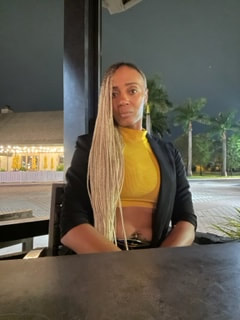
With burning eyes, I did my thing. The next stop was shopping at the outlet mall. As we entered the shopping area this yt woman walked towards me as she complimented my hair; while she asked me if it was all mine (while all in my personal space), proceeded to wrap my 58-inch blonde micro braids/twists around her wrists like she was about to lasso a friggin’ hog. I had an outer body experience. I was in shock at first. I was like what the eff is happening here? I mean, my God, we hear about these stories all the time from Black women and women of color and even children who have experienced this racist behavior. I snapped out of that “think fog” real quick and “yuck my hair” (Bahamian slang) out her friggin’ hand and said NO! As I analyze this egregious infraction by this woman who clearly should have asked me about my CaribFunk body and how she could get one, (intent implied), but instead she chose to walk in the line of her ancestors, the ones who have no boundaries, believe that they have carte blanche to do whatever they feel like to Black bodies, and operate in white privilege. How many times do you have to be told to keep your god damn frowsy hands to yourself? I don’t know what stinkin’ food, body part, or crustation you touched before you touched my crown. How dare you! Clearly when she saw me, she thought I was her Black beauty, toy, stallion, or any other exotic item that she believed she was well within her right to assault, accost, and violate. I was offended. This is a MICRO AGGRESSION!! Had I cussed her a$$ out, then that would have been another issue. I would say go and read about Black women and why they don’t want their hair touched, how this is a micro aggression (I’m sure she has no idea what that means), and how she and most yt women who engage in this practice are operating in “privilege and power” but hey all the books and articles are banned in this state. THIS IS WHY WE NEED BLACK HISTORY TAUGHT AND DISCUSSED ALL OVAHHHH! The muther effin’ nerve…PERIODTTT!!
 
Anyway, this experience didn’t disrupt the remainder of my trip or mood, it (again) serves as commentary for my writing…
 
“The [B]lack body, including skin color and hair texture, has served as markers of Otherness separating Black people from people of other racial groups. Because of this, the [B]lack body especially that of the female, is frequently subjected to the interrogation by non-[B]lack people.” (Collier 2021, 1)
 
Collier, Zakiya. 2021. “Don’t Touch My Hair”: An Examination of the Exercise of Privilege and Power Through Interracial Hair-Centered Communication Interactions,” Proceedings of the New York State Communication Association, Vol. 2017 (11).
 
#dancewriter
#culturalcritic
#donttouchblackwomenshair 

0 Comments

Urban Bush Women: Haint Blu (2023)

3/14/2023

0 Comments

 
Picture
​Haint Blu, “[the] multi-year project created by legendary movement collective Urban Bush Women…premier[ed]” (liveartsmiami.org) at the Historic Hampton House March 9-12, 2023. As I read critiques of praise and excitement by attendees on social media, I thought about their words and the description of their experiences and waited patiently for my turn on Saturday night. When I entered the space, I started to make the immediate left to the courtyard area, since that’s where I went for the previous performance in November (2022) and was quickly redirected by the ushers to the café. I was pleasantly surprised when I saw the set up. There were high and low tables and chairs. It was a full house. Guests were laughing, chatting, drinking beverages from the bar, and/or watching the screen which at times projected civil rights leader Martin Luther King Jr., who from what I understand was a guest there; there were also scenes with former company member Melissa Cobblah Gutierrez. Music was playing softly in the background, adding a particular ambiance that was nice. I scanned the room for familiar faces and saw several local scholars, artists, and professors, even former UBW company member and South Florida native Stephanie Mas. 
 
After about 15 minutes we were welcomed by a member of the Live Arts Miami Staff and then introduced to The Historic Hampton House Brand Manager, Edwin Shepard. Co-artistic director Mame Diarra Speis entered the space, asked us to look at our program, find the inner paper, look on the back to see what number we had, and sent us on our way with the guides. I had number 1 on my sheet. I walked with my group to the first stop on the journey which featured co-artistic director Chanon Judson and two Miami Dade College/Jubilation Dance Ensemble MDC/JDE student performers. Guests gathered in the space. Some were seated while others stood. Everyone listened deeply to Channon’s words which included information and directions for traveling “in safety and in care” while watching her body give and take energy. Her shoulders rolled forward with fists clenched. She contorted her chest, stepping forward, over her imaginary bridge or gateway. She swayed her upper body like a palm tree in the hot wind of the Savannah and rolled her neck, torso, and hips. The MDC/JDE performers anchored Channon walking forward with their blue fabric. Are they gatekeepers? My eyes are drawn to the table placed in the corner where I was standing, covered with a beautiful crème fabric. There are note cards placed on the edges of two corners of the table as well as various gold trinkets—bells, shells, and a small basket. This was an enigmatic yet lucent embodiment of African spirituality. I was intrigued and curious to see what was next on the journey. We were sent on our way while several other MDC/JDE members danced us to our next location in the courtyard. There were hand washing stations facilitated by dance program director at MDC and artistic director of JDE Michelle Grant Murray as well as Olujimi Dance Collective company member Shanna Woods. Givers Revival provided a drink bar that offered cool and refreshing drinks –I had a delicious womb strengthening lemonade. There was also an intricate alter space constructed by healer, ritualist, and restorative justice practitioner Wakumi Douglas. At the alter we were afforded the opportunity to either meditate, write a prayer, or connect with and write an ancestors name down and place the paper on the alter. This was a magnificent and necessary beginning to the work. The elements of African spiritually offered by Douglas, Grant-Murray and the Olujimi Dance Collective provided a grounding that is essential based on the premise of the piece which, “explore[s] the movements histories, and stories, of community elders, [and] ancestors” (liveartsmiami.org). 
 
What I viewed previously in November 2022 at the first iteration and what “I saw” (Warren 2022, 29) and felt via the “psycho-meta-emotional-spiritual” (Gottschild 2022, 30) at the premier were different. I had several questions concerning intention, spiritual embodiment versus performance of spirituality, and how the concept of “Haint Blue” which is a ritual involving painting the ceiling or roof of a homes in the South blue to ward off spirits was imparted and evidenced (non-superficially) in the work. That might be a question for the dramaturg as well. 
 
Overall, this is undeniably a “dance theater” work. It is interactive; the community travelled through the space, room to room, experiencing deep mythical expressions of longing, memory, and sacred healing elements. We also were enthralled in dance/house party vibes, offering a cacophony of sound and movement. The dancers performed superbly, both UBW and MDC/JDE. Those young dancers are a force, they held their own, and yet provided the necessary support for UBW.
 
From an aesthetic perspective, this UBW company offers a different movement vernacular as opposed to what I remember what UBW presented several years ago. I am still thinking about what this means to me —the groundedness and openness of the hip, African aesthetics, looseness and articulation of the torso and extremities, and that fiyah batty. Much of the choreography is devoid of these elements. Grace Galu Kalambay, vocalist and musician, was fantastic. She rocked the house with her sultry rhythm and blues performance offering another dimension to the work while also leveling out some of the schism. I loved the gold netting costume with the black trunks/body suit underneath. This visual conjures up multiple visions and memories of our ancestors either as fisherwomen/men or being fished and hunted by white murderers. The imagery is stunning. 
 
In November, as I stated in my mini reflection, the (then) work in progress was piercing, poignant, and powerful. It centered Blackness, Black culture, and offered a space/place for Black women to “heal and [be] present [while] we are in a constant state of erasure” (Nadege Green 2022). This is still an accurate statement. Haint Blu should be seen and experienced. Thank you for the Bush Medicine!
 
Asantewaa, Eva Yaa. 2022. “As We See It: Black Elders On Writing on Dance: Eva Yaa Asantewaa in Conversation with With Brenda Dixon-Gottschild and Charmaine Warren. Movement Research Performance Journal (56).
 
Image 1: Shanna Woods, A’Keitha Carey, and Apon Nichols
Image 2: Chanon Judson, Alaina Spears, and Stephanie Franco
Image 3: Wakumi’s alterspace
Image 4:  Grace Galu Kalambay
Image 5:   UBW in gold netting
Image 6.: Chanon Judson and Mame Diarra Speis


0 Comments
<<Previous
Forward>>

    Author

    I am writing about dance, fitness, Caribbean culture, race, cultural studies, body politics, and popular culture.

    Archives

    December 2025
    November 2025
    August 2025
    July 2025
    June 2025
    January 2025
    November 2024
    July 2024
    June 2024
    April 2024
    March 2024
    February 2024
    January 2024
    December 2023
    October 2023
    September 2023
    August 2023
    May 2023
    April 2023
    March 2023
    February 2023
    December 2022
    November 2022
    October 2022
    February 2019
    May 2015
    April 2015
    January 2015

    Categories

    All

    RSS Feed

Proudly powered by Weebly